

Kristine Mann
(1873-1945)
— Pioneer in Psychoanalysis
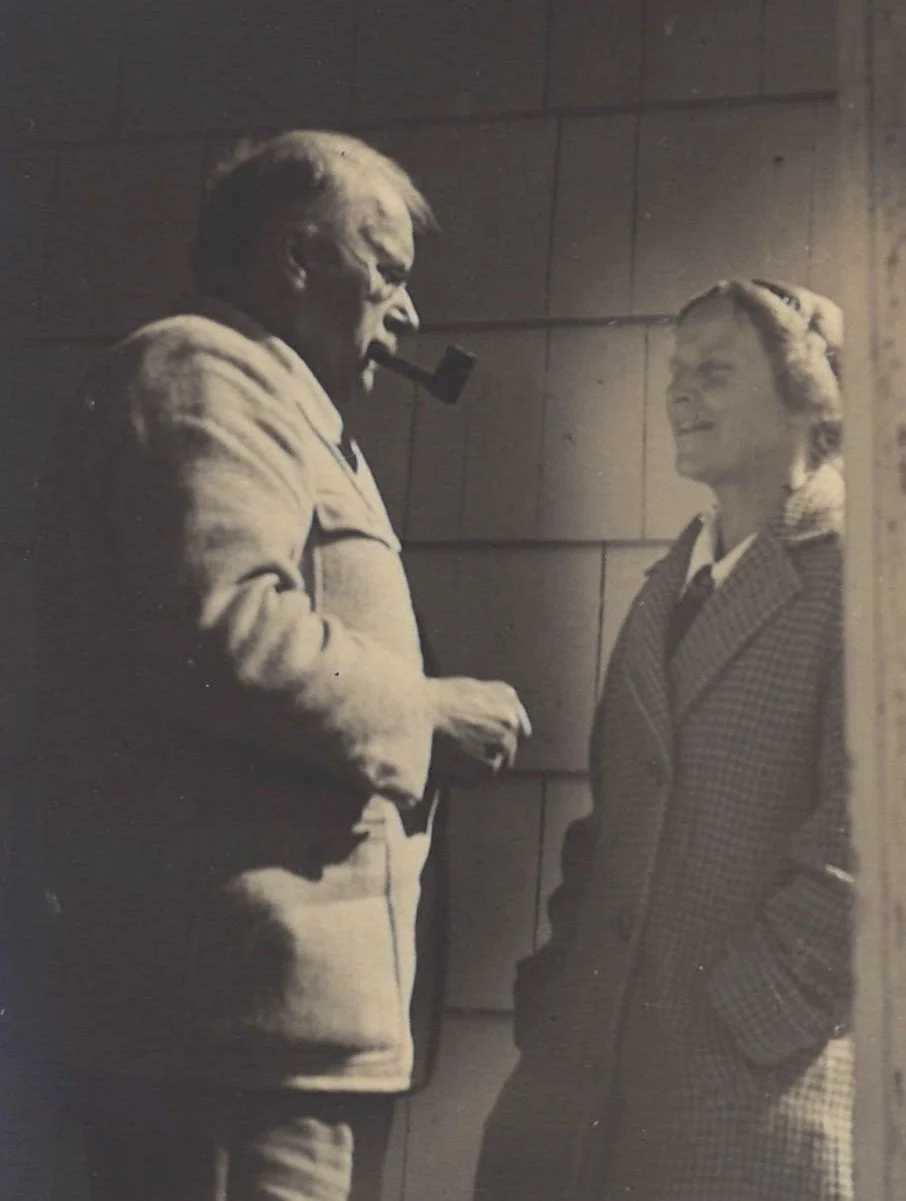
Carl Jung and Kristine Mann, Bailey Island (Maine) 1936.
photography by Frances Bode
Kristine Mann Timeline
1873 – Kristine Mann is born on August 29th, 1873 in Orange, New Jersey. Her father Charles Holbrock Mann (1839-1918) was a minister in The New Church – Swedenborgianism, a theological tradition of several historically related Christian denominations that developed under the influence of Emanual Swedenborg (1688-1772). Her mother was Clausine Borchsenius who had emigrated from Rudkobing, Denmark when she was 14. Kristine Mann grew up with two older brothers, Horace and Riborg; an elder sister, Clausine; a younger sister Anna; and a younger brother Holbrock. Kristine's life of education began at age four at the Dearborn Morgan School in Orange from which she graduated at age eighteen.
1885 – Kristine and her family begin spending summers at Bailey Island in Maine. Summering at Bailey Island would prove to be a lifelong ritual for Kristine and her friends and family.
1891 – Kristine enters Smith College, a liberal arts women’s college in Northampton, Massachusetts.
1895 – Kristine receives her degree from Smith and returns to Orange, NJ where she assists her father as editor of the New Church Messenger, the official newsletter of the Swedenborgian General Convention. Charles Mann’s conflicts with the New Church deepened to the point that he severed ties with them in 1897 and founded a new periodical called The Secular Church. Kristine continued to grow up in this somewhat unorthodox New Church family setting.
1900 – Kristine attends the University of Michigan where she receives a Masters of Arts degree, after which she goes on to teach English for four years at Vassar College. She subsequently taught at the Brearely School in New York while pursuing graduate studies in education, philosophy, and psychology at Columbia University.
1907 – Kristine begins the study of anatomy at Women’s Medical School and enters Cornell Medical School. At Cornell she became reacquainted with Eleanor Bertine (1887-1968), who was previously her student at Vassar and would become her lifelong friend.
1913 – Kristine receives her medical degree, becoming Dr. Kristine Mann at the age of 40.
1914 – Dr. Mann moves to New York to begin a two-year investigation of the health conditions of sales women for the New York Department Store Education Association.
1915 – Dr. Mann’s pens an article entitled “Training Women for Marriage”, which is published in the Smith Alumnae Quarterly and articulates her belief in the necessity for women to work to attain confidence in their autonomy.
1916 – The Psychology Club Zurich is founded by Emma and Carl Gustav Jung and some of their friends studying Complex Psychology (later changed to Analytical Psychology). Emma Jung was the first president of The Psychology Club Zurich.
1914-1918 – During World War I Dr. Mann works for the Army Ordnance Department, supervising the health of women in munitions plants in Washington D.C.
1918 – After the war Dr. Mann works for the Work Council of the YWCA, visiting twenty colleges for women. This was to conduct an intensive study on the psychology of sex, euphemistically referred to as “social hygiene”.
1920 – An article refers to Dr. Kristine Mann as “one of America’s most distinguished women physicians.”
1920 – On August 18th, 1920 the Nineteenth Amendment becomes part of the U.S. Constitution and Women in the US obtain the right to vote. It states: The right of citizens of the United States to vote shall not be denied or abridged by the United States or by any State on account of sex.
1920-1924 – Dr. Mann becomes the Director for the Health Center for Business and Industrial Women in New York. During this time she meets Dr. Constance Long (from London), whose influence on Dr. Mann regarding the ideas of Carl Jung resolves her to enter the new field of Analytical Psychology.
1921 – Dr. Mann studies with Carl Jung for the first time. She also begins practicing as an analyst part-time. Dr. Mann studies in Europe with Jung several more times during the early 1920s.
1923 – Dr. Mann publishes Thousands of 'Well' Women Pay for Training Health Center, New York Times, Section 8, Page 15 (April 1, 1923).
1925 – Dr. Mann hosts a lecture by Carl Jung in her New York apartment.
1928 – Dr. Mann travels to Zurich. She considers the Swedenborgian idea of “‘groping towards a system of psychological healing” to be her new vocation, and with the help of her friends she begins to shape the Jungian Community in New York.
1936 – The Analytical Psychology Club of New York was founded. Formed by Dr. Mann, Mary Esther Harding (1888-1971), and Eleanor Bertine (1887-1968), its purpose is to provide a gathering place for self-discovery and to gain an understanding of the key components of Jungian therapy.
1936 – The ‘founding mothers’ of Analytical Psychology in America (Mann, Harding, and Bertine) organize Carl Jung’s visit to Bailey Island, Maine. At the Bailey Island Library, Carl Jung gave the week-long seminar “Dream Symbols of the Individuation Process.”
1940 – Dr. Mann publishes “The Shadow of Death” in and “The Self-Analysis of Emanuel Swedenborg” in Papers of the Analytical Psychology Club of New York vol. 4.
1941 – The Library of the Analytical Psychology Club of New York (APC) is established and within a few years it shall become the Kristine Mann Library.
1945 –After a long and difficult battle with breast cancer, Dr. Kristine Mann dies and leaves her personal collection of over 400 Jungian books and papers to the Analytical Psychology Club of New York (APC), which forms the nucleus of the library today. Upon her death, the library was named in her honor and eventually moved to a pleasant suite in the Peter Cooper Hotel, New York.
1955 – The Kristine Mann Library endowment fund is created.
1963 – The Kristine Mann Library committee is formed.
1975 – The library relocated to its current home in a midtown New York City brownstone. The building also houses the C.G. Jung Center of New York along with the C.G. Jung Foundation, their bookstore, the C.G. Jung Institute, the Analytical Psychology Club, ARAS (The Archive for Research in Archetypal Symbolism), and the New York Association for Analytical Psychology.
The Library for Jungian Research in New York is named after one of the ‘founding mothers’ of Psychoanalysis Dr. Kristine Mann. It was Kristine Mann who along with Mary Esther Harding (1888-1971), and Eleanor Bertine (1887-1968) founded the Analytical Psychology Club of New York (APC) in 1936 to provide fellowship to persons who had experienced Jungian analysis. They were the pioneers of Analytical psychology in the United States. During the 1920s and 1930s these women underwent analysis by Carl Jung and his colleagues both in America and in Zurich and established their own practices. They were responsible for bringing Carl Jung to America, to New York and to Bailey Island, and to creating a direct relationship with the Psychology Club in Zurich. In 1941 they established The Library of the Analytical Psychology Club of New York (APC) and after the death of Kristine Mann in 1945 it would become the Kristine Mann Library.
For further information about the life of Kristine Mann read Beth Darlington’s wonderful article from Eranos (Spring 2015) “Kristine Mann: Jung’s “Miss X” and a Pioneer in Psychoanalysis”.